
FDA Peptides Meeting July 2026: What Happens After the PCAC Vote
On July 23–24, 2026, FDA’s Pharmacy Compounding Advisory Committee (PCAC) will review seven peptides for potential inclusion on the 503A Bulks List. This discussion extends beyond headlines about “popular unproven chemicals.” It is a regulatory and drug safety matter with direct implications for compounders and patients nationwide. We examine which peptides will be reviewed, the regulatory steps that follow the PCAC meeting, and what the outcome could mean for patient access and the broader future of personalized medicine.
Peptides to be Reviewed by FDA on July 23–24, 2026
FDA will review the following peptide bulk substances for potential inclusion on the 503A Bulks List:
July 23: BPC-157, KPV, TB-500, MOTs-C
July 24: Emideltide (DSIP), Semax, Epitalon
Each will be evaluated in both free base and acetate forms.
Comment Deadline for Stakeholders
Compounders have until July 22 to post comments to the FDA. An earlier cutoff of July 9 applies for comments to be shared directly with advisory committee members before the meeting.
If there is to be a bright-line pathway for 503A pharmacies to compound peptides for individual patients under prescription, stakeholders should actively participate in these regulatory discussions.
If 503As, prescribers, and patients would like to see the seven peptides put on the final 503A FDA bulks list, they should provide science-based rationale comments to FDA Docket by the deadline.
While compounders are central to the discussion, more submissions from prescribers and patients should be encouraged.
What Information Can Prescribers Provide?
Prescribers can provide insight into:
Why patients are seeking peptide therapies
Where existing treatment options may have limitations
How peptides have been incorporated into individualized treatment plans
Real-world experiences with patient outcomes
Why Anonymized Industry Data Matters
The goal is not to share patient information or identify individual practices. Instead, the industry is looking for broader insights, such as:
Patient demographics
Volume of prescriptions
Clinical use cases
Real-world outcomes
Experiences with patient populations
Some pharmacies may be hesitant to provide information. However, anonymized industry data could help FDA better understand the real-world role these therapies have played.
Why Patient Perspectives Matter
Patients can also share their experiences, including situations where existing therapies did not provide the results they needed.
Although anecdotal information does not replace controlled clinical trials, real-world evidence may help provide context, particularly when evaluating therapies already being used in practice.
What to Expect After the Meeting
While many outlets have reported about FDA’s upcoming PCAC review, some miss explaining what happens after the vote.
The outcome could have major compliance and business implications for 503A compounding pharmacies, telehealth companies, and others involved in peptide prescribing and dispensing.
Understanding the next steps is important because the July meeting does not itself amend the 503A Bulks List or immediately add any substance to 21 CFR § 216.23.
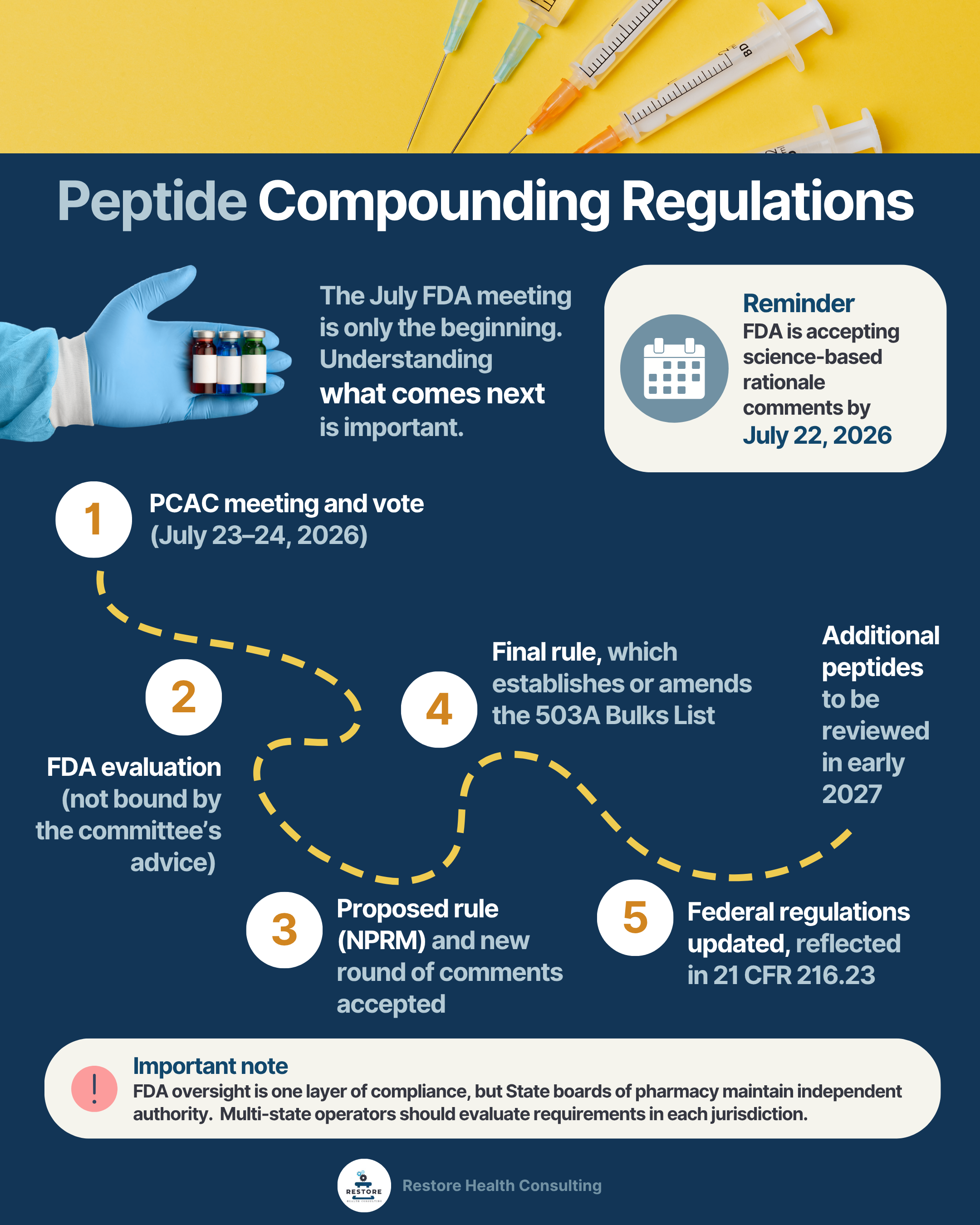
Here’s what to expect after the comment period closes:
PCAC meeting and vote
PCAC reviews the scientific evidence and comments and may vote on whether each peptide bulk substance should be included on the 503A Bulks List. The committee's role is advisory.
FDA evaluation
FDA considers the committee's advice but is not required to follow it. The agency also consults with USP and evaluates safety, effectiveness, historical use, and other criteria established in 21 CFR 216.23.
Proposed Rule
According to FDA’s own 503A interim policy, the agency will publish a Notice of Proposed Rulemaking (NPRM) upon completing its evaluation. The NPRM will identify substances it proposes to place on the 503A Bulks List and substances it evaluated but proposes not to include. The public then gets an opportunity to submit comments.
Final rule
After reviewing comments, FDA publishes a final rule. That final rule establishes or amends the 503A Bulks List and identifies substances that were evaluated but ultimately not placed on the list.
Federal regulation updated
Once final, FDA would amend 21 CFR § 216.23 to identify substances added to the 503A Bulks List and/or substances evaluated but not included.
Importantly, even if a substance is ultimately added to the 503A Bulks List, that does not mean the compounded drug is FDA-approved or FDA-endorsed.
State Pharmacy Boards Still Have Authority
Finally, FDA oversight is only one layer of compliance.
State boards of pharmacy maintain independent authority. Some jurisdictions have adopted (or may decide to adopt) peptide compounding policies that are more restrictive than federal requirements. Multi-state operators should evaluate applicable requirements in each jurisdiction.
The July meeting is only the beginning of the regulatory process, not the end.
It will be worth watching not only how PCAC votes, but how FDA proceeds through rulemaking and how states respond in the months that follow.
Peptides to be Reviewed by FDA in Early 2027
The FDA will also review the following five additional peptide bulk substances at a separate PCAC meeting before the end of February 2027:
Cathelicidin (LL-37)
GHK-Cu*
Dihexa acetate
MOTs-C
Mechano Growth Factor, Pegylated (PEG-MGF)
*Non-injectable GHK-Cu is currently on the 503A Category 1 bulks list.
The Peptides Conversation Behind the Headlines
The FDA’s upcoming review of peptides is not only a regulatory discussion. It is also a broader conversation about patient access, pharmacy standards, personalized medicine, and the role of real-world experience in shaping future policies.
To explore these issues in greater depth, Restore Health Consulting has launched Compounding Interest: The Business of Personalized Medicine Podcast.
In the inaugural episode of Compounding Interest, Restore Health Consulting CEO Amy Summers, PharmD, BCSCP, FAPC, speaks with Melissa Steffco, Senior Vice President of Regulatory Affairs at Wells Pharmacy Network and Board Member of the Alliance for Pharmacy Compounding, about the issues facing compounders, prescribers, and patients ahead of FDA’s July 2026 PCAC meeting.
In this conversation, Amy and Melissa discuss:
Why peptide regulation has become a critical issue for personalized medicine
How regulatory changes have affected access to peptide therapies
The patient safety concerns surrounding gray market sourcing
The role of pharmacies, prescribers, and patients in the FDA comment process
What different regulatory outcomes could mean for the future of peptide compounding
Whether you are a compounder, prescriber, or healthcare professional involved in personalized medicine, this discussion provides additional context on what is at stake in FDA’s peptide review and what different regulatory outcomes could mean for the industry.
Disclaimer: This article is intended to provide general information on U.S. compounding. It should not be construed as legal, regulatory, or medical advice. Readers are encouraged to consult an attorney for guidance specific to their circumstances.