16-Fold Increase In Sustainable Sterile Compounding Capacity
Client Type:
A licensed sterile compounding pharmacy preparing compounded sterile preparations (CSPs) from non-sterile bulk pharmaceutical ingredients and excipients.
Engagement Summary:
A licensed sterile compounding pharmacy engaged Restore Health Consulting to address significant production bottlenecks and compliance concerns. Existing inefficiencies limited output and threatened scalability.
The Challenge
At baseline, the pharmacy was producing approximately 90 sterile units every other day (or roughly 45 units per day), despite having the physical infrastructure to support significantly higher throughput.
Identified constraints:
Manual, time-consuming processes with frequent changeovers that reduced quality.
Inefficient material and personnel flow funneled through a single cleanroom suite.
Underutilization of available controlled environments.
Lack of standardized workflows and production sequencing.
Our Solution
Restore Health Consulting performed a comprehensive operational and facility workflow assessment, focusing on five key areas:
1. Process Mapping: We identified every step in the compounding and setup process and separated value-added activities from non-value-added ones. This gave us a clear picture of where time was being lost and where interventions would have the highest impact.
2. Environmental Utilization: We evaluated air classifications, pressure differentials, and operator flow patterns to understand how the physical environment was being used, and where it wasn't being used at all. The goal was to maximize productivity within the existing single buffer/ante room configuration.
3. Equipment Optimization: Rather than recommending new equipment purchases, we redesigned workstation layout around the existing laminar airflow workbench (LAFW) and powder containment hood. The focus was on reducing idle time and minimizing unnecessary cleanroom re-entry, two of the most common hidden time sinks in sterile compounding operations.
4. Personnel and SOP Alignment: We revised training protocols and compounding SOPs to standardize setup, cleaning, and documentation sequences. This reduced transition time between compounds and eliminated the variability that came from staff improvising steps that should have been defined.
5. Scheduling Strategy: We implemented a sequencing model that brought environmental monitoring, setup, and production tasks into continuous, non-overlapping blocks. This prevented the start-stop patterns that had been fragmenting the production day.
The Result
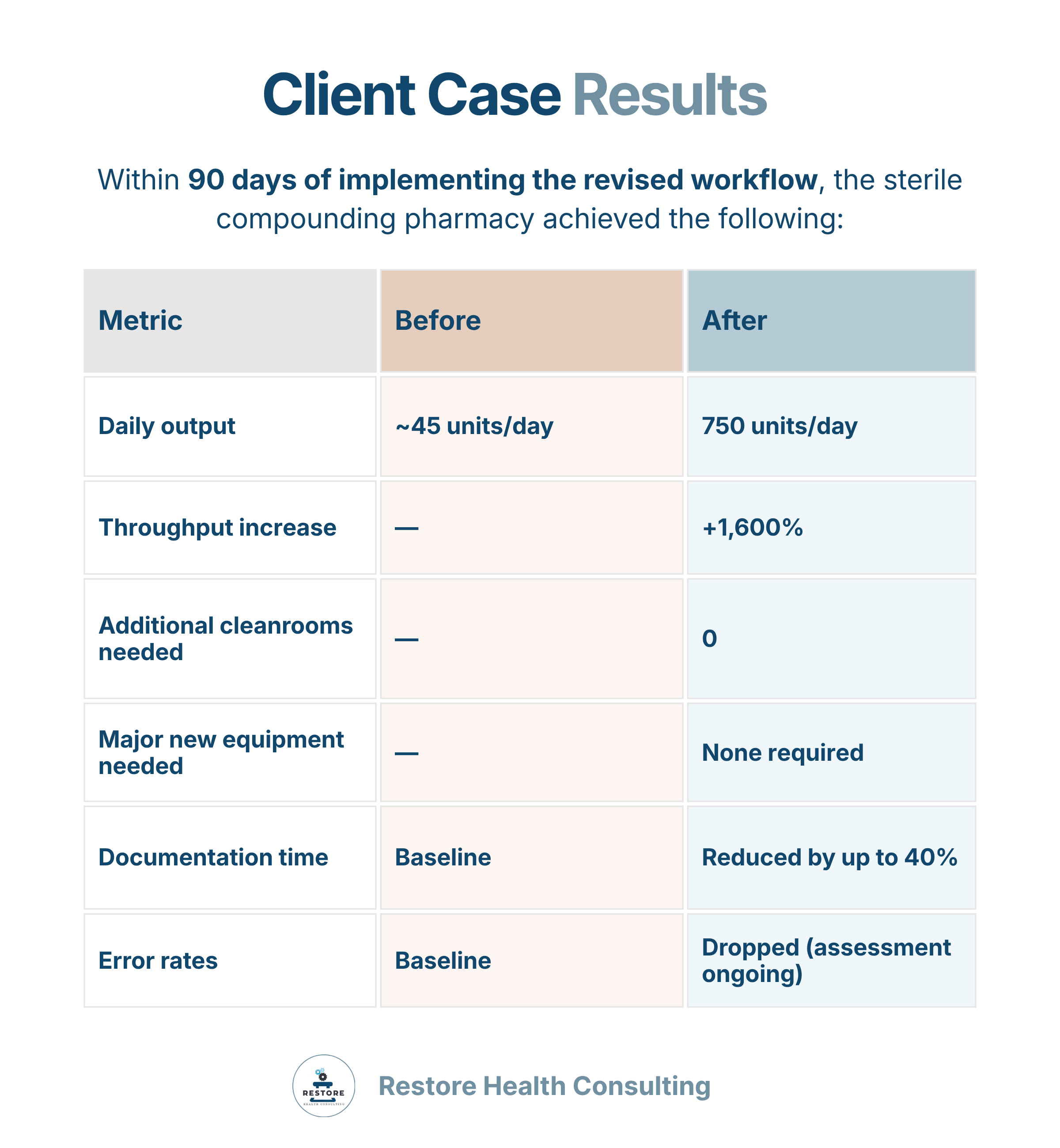
Equipment used throughout: one buffer room, one ante room, one LAFW, two balances, one powder hood, one pump, and one crimper. Upgrades to the powder hood, balances, and pump were elective, not required, to achieve these results.
The facility’s workflow changes were designed to align with applicable State Board of Pharmacy regulations and USP <797> standards throughout the optimization process, and the site was prepared for NABP accreditation during the engagement (accreditation was achieved in the months that followed).
In tandem with throughput improvements, we supported the site in implementing Category 3-aligned garbing, cleaning, and environmental monitoring controls.
Client Impact
Restore Health Consulting transformed a production-constrained operation into a scalable, high-performing sterile compounding environment. Through leveraging existing assets, workflow optimization, process standardization, and regulatory alignment, the pharmacy increased capacity by roughly 16 times while strengthening quality systems and compliance readiness. Dramatic gains in both throughput and profitability were achieved.
The resulting improvements supported sustained growth and profitability, greater operational efficiency, and successful NABP accreditation.
Are you operating at full capacity?
In many sterile compounding environments, production limits are not driven by space or equipment, but by how work flows through the existing system.
Restore Health Consulting offers an introductory consultation to help identify where capacity may be constrained and whether a structured workflow assessment could provide value. There is no obligation and no predefined solution assumption, only a review of current operational constraints.